Summary: The useful test for fan direction happens under the fan: in warm weather, you generally want a noticeable downward breeze where people sit or sleep; during heating season, you may want low-speed circulation without a draft. Because “clockwise” depends on where you are looking and some models work differently, verify airflow instead of trusting a slogan.
The quick direction check: stand below the fan
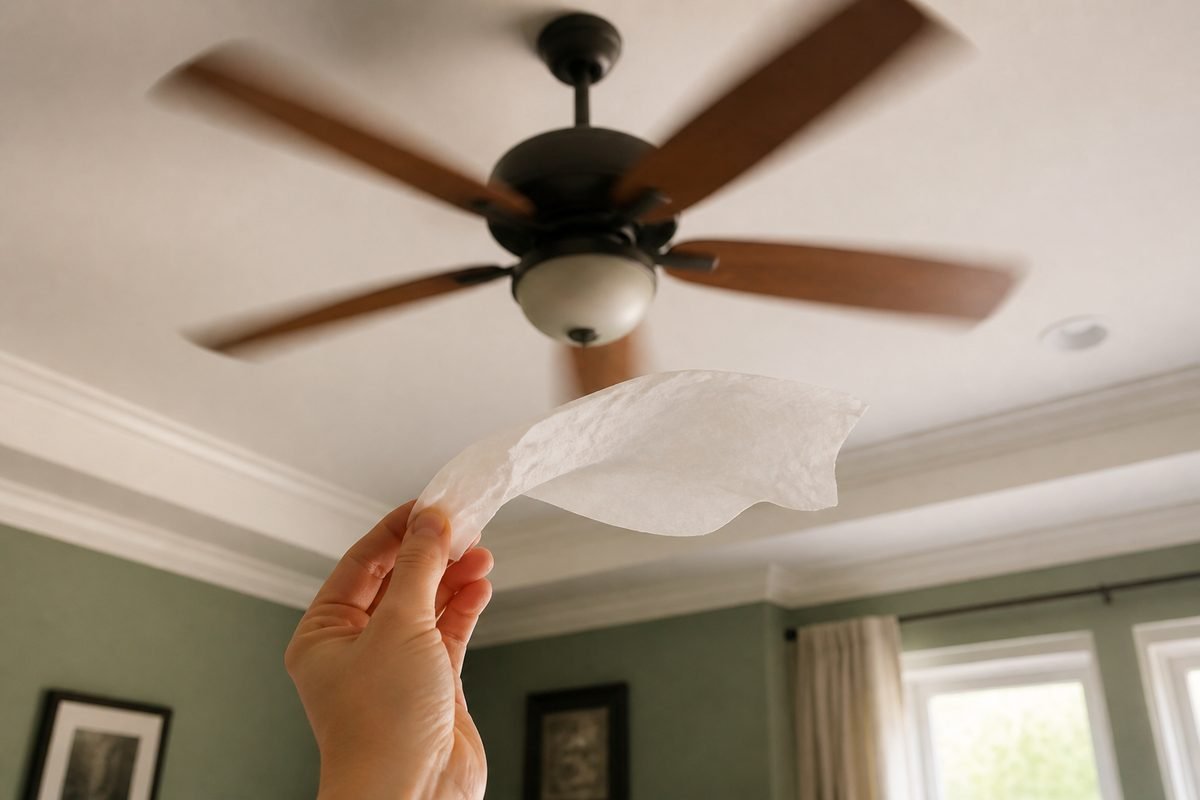
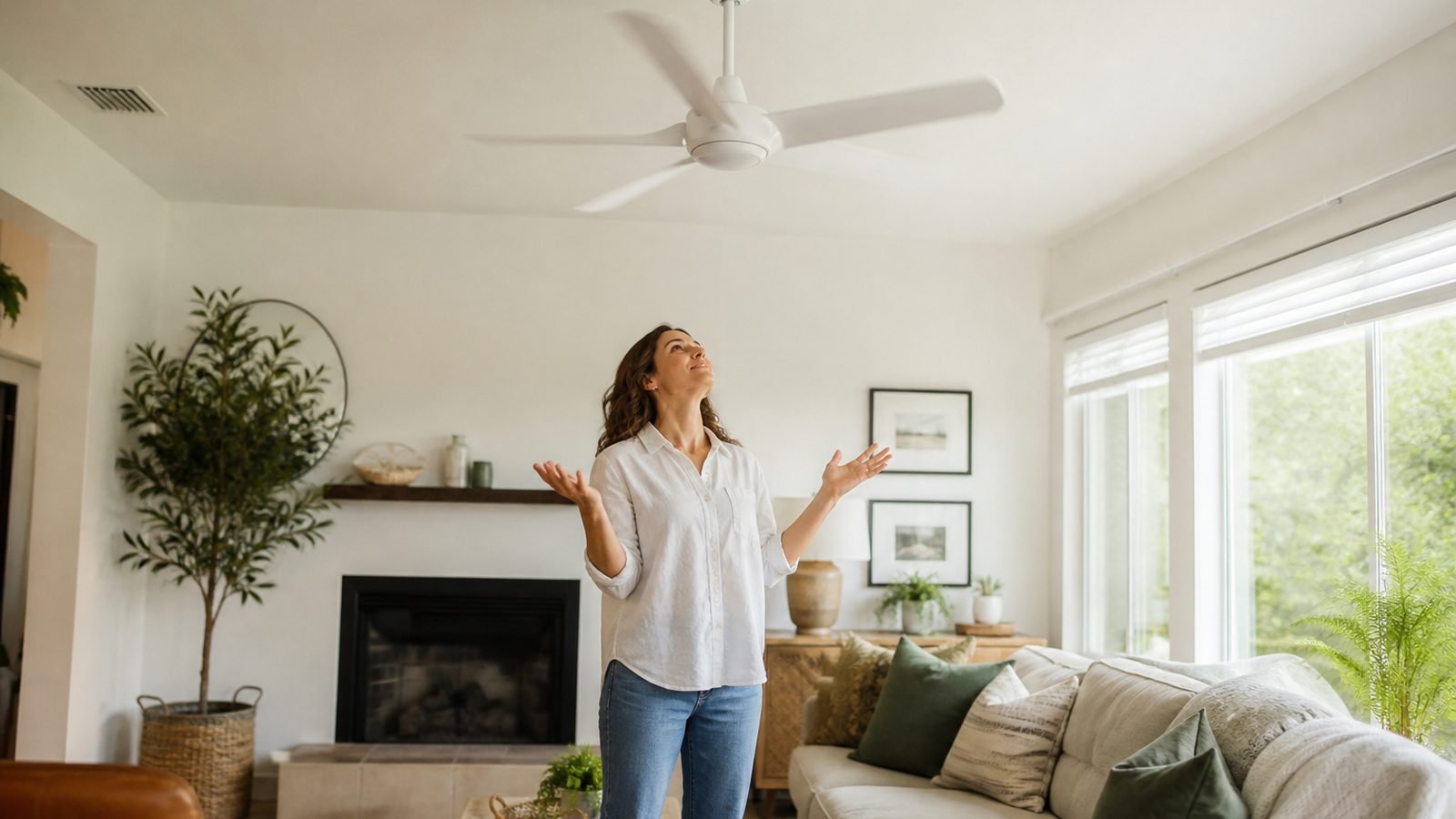
Do not begin by guessing whether the blades are moving clockwise. Turn the fan on at low speed, stand on the floor directly below its center, and look up. More importantly, notice what the air does at your face, arms, and the height of the furniture you use. For warm-weather comfort, the blades should push air down so you feel a steady breeze beneath the fan. A narrow strip of tissue held at chest height can make weak airflow easier to see, but keep all objects well below moving blades.
For heating-season mixing, the goal is different. You usually want the fan to draw air upward near the center and move warmer ceiling air outward and down along the walls. From the occupied part of the room, that circulation should be subtle. If you feel a cold draft on the sofa, desk, or bed, lower the speed or turn the fan off. A fan does not create heat, and mixing is not automatically helpful in every room.
How to change ceiling-fan direction safely
- Turn the fan off. Wait until every blade has stopped completely. Never reach toward a coasting fan.
- Read the model instructions. A traditional fan may have a small slide switch on the motor housing. Newer fans may reverse from a remote, wall control, or app. Do not force a switch that does not move normally.
- Cut power before reaching near the motor housing. Switch off the appropriate breaker if you must climb a ladder to use a physical reverse switch. A wall switch alone may not isolate every conductor or remote receiver.
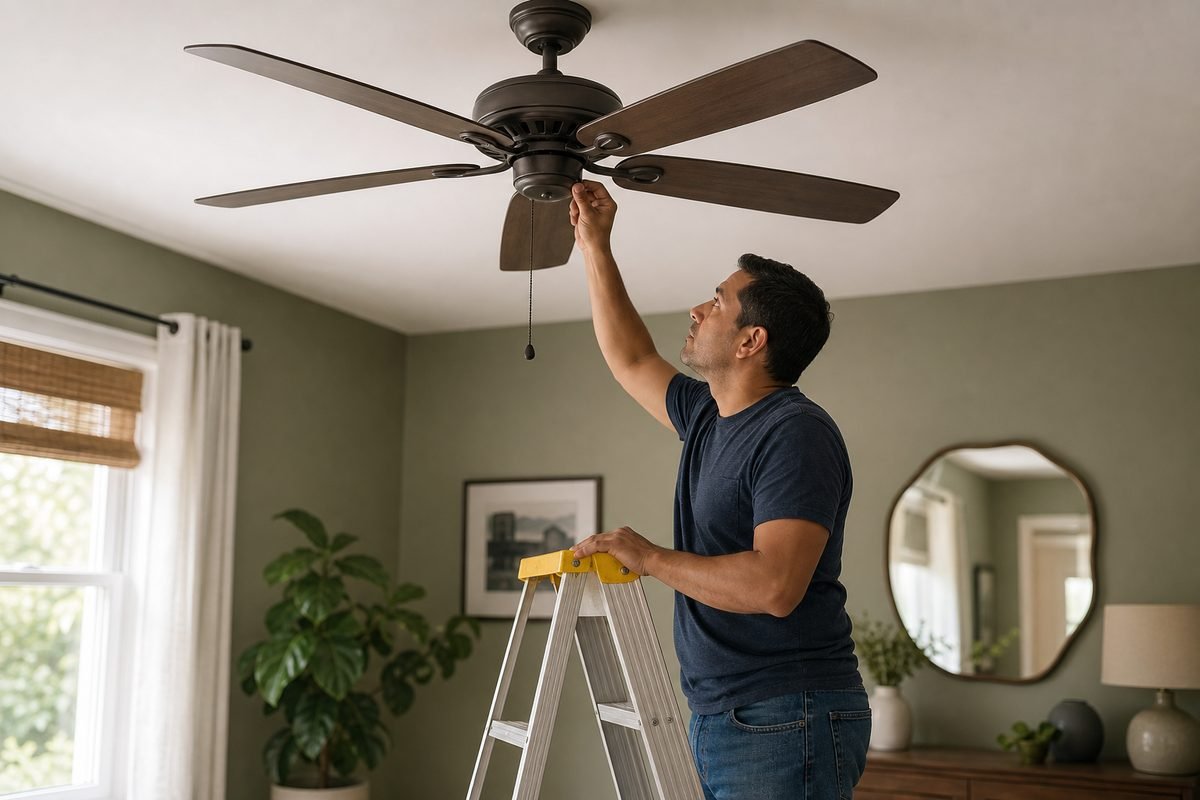
- Use a stable ladder on a level floor. Keep your belt buckle between the rails, ask another adult to steady the area, and never stand on a chair, bed, or table.
- Move the reverse control only as the manual directs. Do not open the canopy, alter wiring, bend blades, or spray lubricant into the motor.
- Restore power and test on low. Stand on the floor, listen for new rubbing or clicking, then check airflow. Turn the fan off if it wobbles strongly, smells hot, sparks, or trips a breaker.
If the fan is above a stairwell, vaulted ceiling, or other location that cannot be reached with an ordinary household ladder, hire an appropriate service professional. Direction changes do not justify a risky climb. Outdoor fans also need the correct damp- or wet-location rating for where they are installed; direction does not correct an unsuitable installation.
Warm-weather setup: create a breeze where people are
A fan can make occupants feel cooler by moving air across skin. It does not lower the room’s air temperature like an air conditioner. Set a downward breeze, start at low speed, and increase only until the person in the occupied zone is comfortable. Turn the fan off when the room is empty unless it serves another documented purpose.
Check at furniture height
Airflow can feel strong while standing and weak while reclining. Sit in the desk chair, lie on the bed, or occupy the sofa for several minutes. Check both sides of a shared bed and each seat at a dining table. A light curtain, loose paper, or plant leaf can reveal where the air lands, but comfort matters more than visible movement.
Coordinate with air conditioning
Choose the fan speed first, allow your body time to judge the breeze, and then make any thermostat change based on actual comfort. Do not promise yourself a particular energy saving or temperature increase. Humidity, clothing, fan size, room layout, and individual comfort all change the result. Keep supply and return vents unobstructed; a fan is not a reason to block HVAC airflow.
Heating-season setup: mix gently, or leave it off
Warm air often collects near a high ceiling. A low-speed updraft may circulate some of that air without blowing directly on occupants. Reverse the fan using the safe procedure, select the lowest speed, and check near an exterior wall as well as in the center. You may notice faint air movement down the walls, but the seating area should not feel breezy.
Compare comfort with the fan on and off under similar conditions. In an eight-foot bedroom with no obvious ceiling-to-floor temperature difference, the fan may add noise and a draft without improving comfort. In a tall great room, gentle mixing may be more noticeable. Stop using the winter setting if papers flutter, plants move continuously, occupants feel chilled, or the heating system’s normal airflow becomes less comfortable.
Room-by-room fan settings
Bedroom
Use a downward warm-weather breeze, usually at low or medium speed, and judge it from pillow height. If one sleeper dislikes direct airflow, reduce speed before changing direction. You can also shift the bed within the fan’s airflow footprint if the room allows. Avoid running a loose extension cord for a fan control, and secure remote batteries away from young children. In winter, use only a draft-free low setting; many bedrooms need no fan while heating.
Living room or family room
Test every frequently used seat. A fan centered over a coffee table may send its strongest air between sofas rather than onto them. Start low, then increase one level while seated. For a tall or open room during heating season, check both the main seating area and an upstairs opening; circulation that helps downstairs can create an unwanted draft elsewhere.
Home office
Set the breeze at keyboard height. Too much airflow can dry eyes, move receipts, and amplify microphone noise. A low downward setting often provides summer comfort without disturbing work. Keep fan remotes separate from switched strips used in an office energy audit; the companion guide on finding phantom loads in a home office explains why network and backup devices need their own shutdown decisions.
Dining room and kitchen
Use the lowest speed that reaches occupied chairs. Test with napkins or a single sheet of paper on the table before serving food. Over a kitchen island, avoid a setting that blows steam, flour, or lightweight packaging across the work surface. A ceiling fan is not a substitute for a range hood, and it should not disrupt smoke or carbon-monoxide alarm placement specified by manufacturers and local requirements.
Nursery or child’s room
Check airflow at crib or bed height, not adult standing height. Keep pull chains, cords, and remotes inaccessible, and do not hang decorations from the fan. Use low speed and stop if the child seems chilled. Follow current safe-sleep guidance for bedding and room setup; a fan setting does not replace those practices.
Porch or covered outdoor area
Use a fan listed for the actual exposure. A damp-rated model is intended for moisture in protected locations; a location exposed directly to rain may require a wet-rated model. In warm weather, use downward airflow toward occupied seating. During cold weather, there is usually little reason to run an outdoor fan merely to “mix” open air.
Vaulted room or loft
Start with low speed because long downrods and large blades can move substantial air. In summer, confirm that the downdraft reaches the occupied zone; a very high fan may need a higher speed, but noise and papers provide useful limits. In winter, compare temperature and comfort at floor level before and after low-speed mixing. Leave installation height, downrod selection, balancing, and wiring to the manufacturer’s instructions and qualified help where needed.
Solve common comfort problems
- The fan turns but there is little breeze: Confirm direction from below, raise speed one step, clean dust from stationary blades according to the manual, and check whether the fan is unusually high or undersized for the occupied area.
- Only one seat gets blasted: Lower speed and test alternate seating positions. Do not bend blade arms to redirect air.
- The fan wobbles: Turn it off. Check for visibly loose hardware only as the manual permits, and have persistent or severe wobble serviced. Never attach improvised coins or weights.
- There is a new clicking sound: Stop the fan and look from the floor for a pull chain touching a light, a loose shade, or an obstruction. Cut power before any permitted hands-on inspection.
- Winter mode feels colder: Reduce to the lowest speed. If a draft remains, turn the fan off; the room may not benefit from mixing.
- Two people disagree: Optimize the occupied zone rather than the whole room. Use lower speed, adjust seating if practical, or run the fan only when the person who wants airflow is present.
Example: one home, four different decisions
A household checks its fans on the first warm weekend. In the bedroom, the fan is already pushing air down, but high speed chills one sleeper, so they select low. In the office, medium speed moves papers, so low becomes the work setting. The living-room fan is high above a vaulted ceiling; medium produces a useful breeze at the sofa, while low does not. The covered porch fan has the correct location rating and runs downward only while people are seated outside.
When heating season begins, they repeat the safe direction-change procedure. The vaulted living room is comfortable with a low updraft and no detectable sofa-level breeze. The standard-height bedroom feels drafty even on low, so that fan stays off. The choices differ because room height, furniture, and occupants differ—not because every fan needs one universal winter setting.
Seasonal fan checklist
- Read the model’s reversing instructions and locate the control.
- Shut off power and use safe access before touching a housing switch.
- In warm weather, verify a downward breeze while standing below the fan.
- Judge speed from the bed, chair, desk, or table actually used.
- In heating season, try low-speed upward mixing and reject any draft.
- Turn unneeded fans off when rooms are empty.
- Stop for strong wobble, heat, odor, sparking, damaged controls, or breaker trips.
- Clean blades evenly with power off; follow the manual rather than bending or adding weights.
Frequently asked questions
Which way should a ceiling fan turn in summer?
Use the direction that creates a downward breeze beneath the fan. On many conventional fans that appears counterclockwise when viewed from below, but verify by standing underneath and feeling the airflow.
Which way should it turn in winter?
If the room benefits from mixing, use the direction that draws air upward near the center, generally on the lowest speed. The occupied area should not feel drafty. Turning the fan off is valid when mixing does not improve comfort.
Can I reverse the fan while it is moving?
No. Turn it off and wait for a complete stop. Follow the manual; cut power before climbing to a physical switch near the motor housing.
Should a fan run in an empty room?
Usually not for personal cooling, because the breeze cools people rather than the room. Follow any model-specific purpose and consider pets or special equipment separately, but do not assume continuous operation stores coolness.
Does fan direction replace HVAC service?
No. A fan cannot correct a failed heating or cooling system, blocked duct, unsafe equipment, or serious room imbalance. Seek appropriate service for persistent HVAC problems.
Conclusion
Set each ceiling fan by what happens where people live: downward airflow for a warm-weather breeze, optional low-speed mixing without a draft during heating season, and a speed suited to the bed, chair, desk, or table. Stop the blades and isolate power before using a housing-mounted reverse switch. Once the direction is right, comfort—not a memorized rotation word—is the practical final test.