Summary: A low-fume method is not a chemical-free method. First remove oily soap film, then test a mild citric-acid solution on confirmed glass while shielding stone and hardware. Short contact, thorough rinsing, and drying let you judge the result without escalating into surface damage.
Identify what is on the glass before cleaning
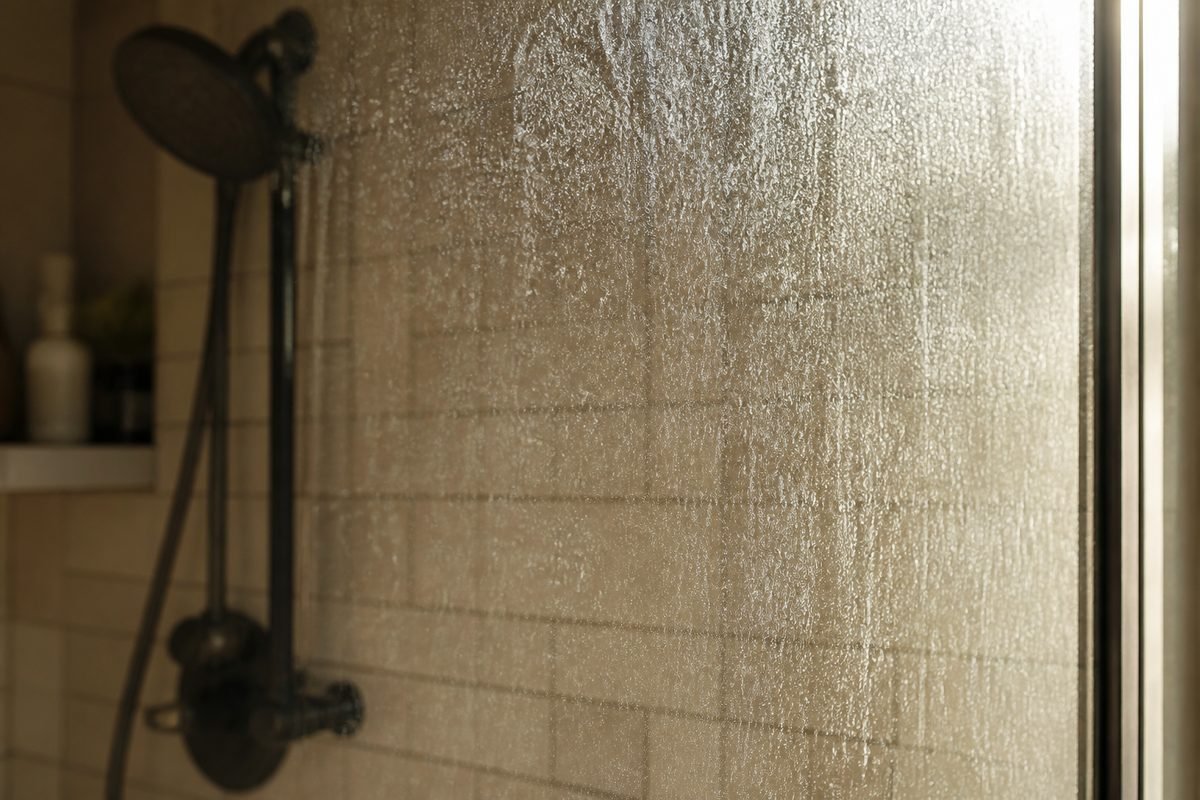
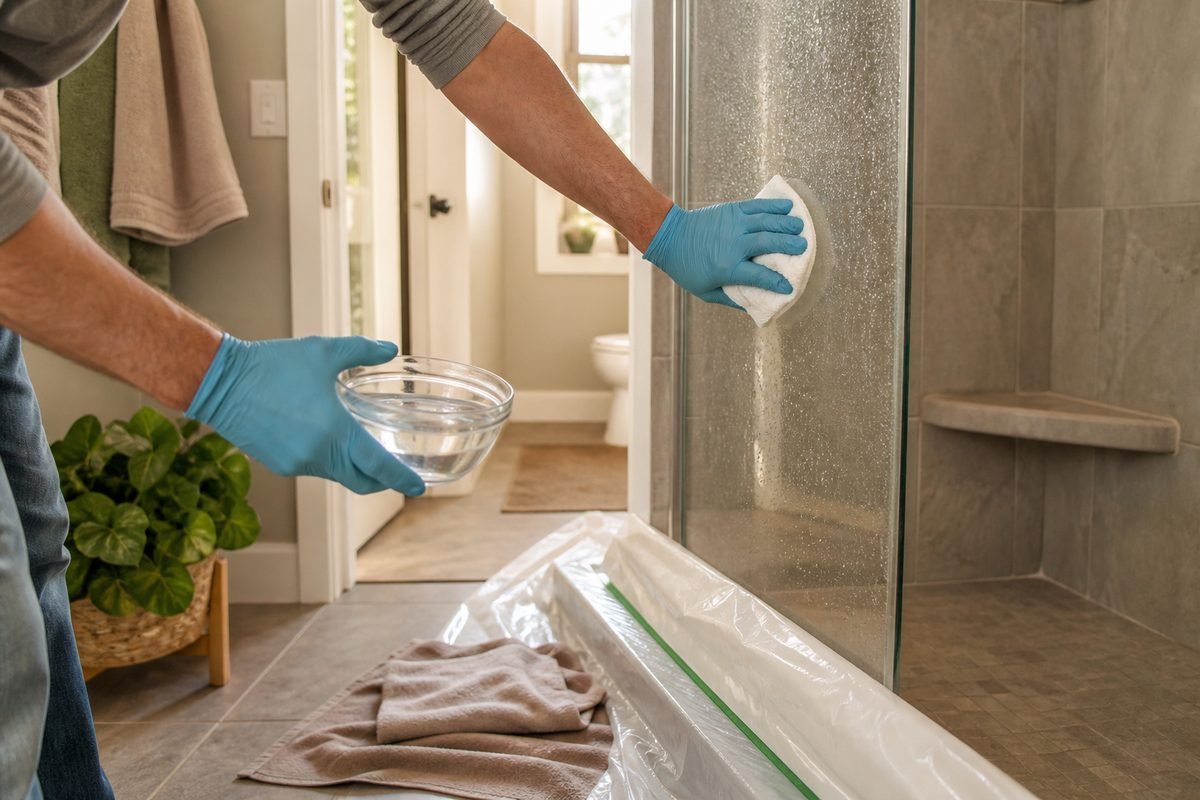
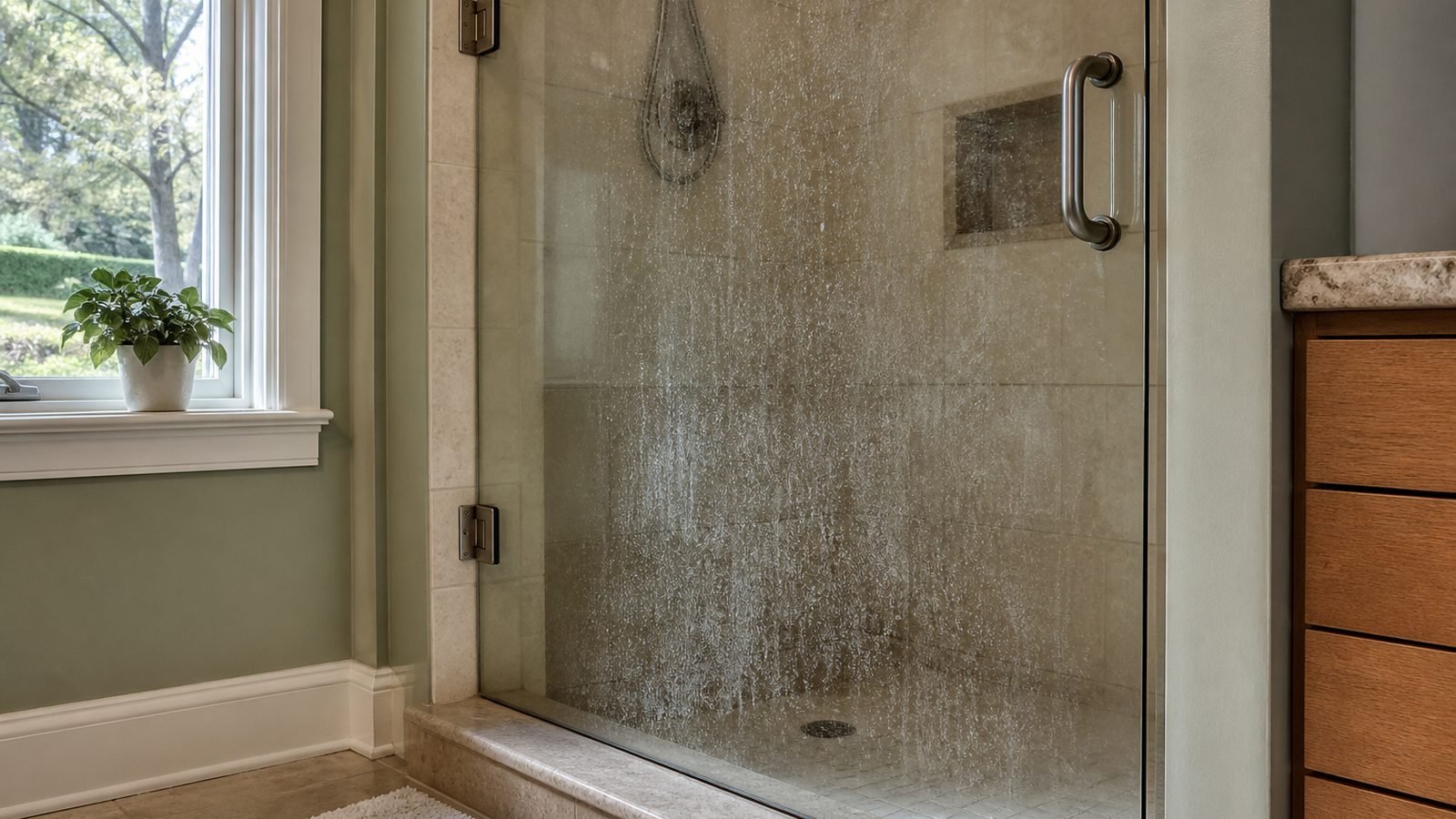
Hard-water spots form when droplets evaporate and leave dissolved minerals behind. Fresh deposits often appear as individual white rings or dots. Older buildup can become a cloudy, rough band along the lower door, where water repeatedly collects. Soap film complicates the job: body oils and soap can create a dull, slightly greasy layer over the minerals, preventing an acidic cleaner from contacting them evenly.
Do a simple dry inspection under side lighting. If the haze changes when you wipe it with a damp microfiber cloth but returns as it dries, mineral residue is likely. If a drop of plain dish-soap solution cuts a clear path, soap film is part of the problem. A uniformly frosted area that feels smooth and does not improve after several careful treatments may be etched glass, damaged coating, or wear rather than removable scale. More acid will not restore glass that has been chemically or mechanically altered.
Confirm that the panel can be treated
Look for the enclosure maker’s label, installation paperwork, or care instructions. Some shower doors have factory-applied easy-clean coatings with product restrictions. Decorative, tinted, textured, laminated, or aftermarket-coated glass may also require a specific cleaner. If you cannot identify the surface, test only an inconspicuous area and avoid abrasive pads, razor blades, polishing compounds, and strong descalers. Manufacturer instructions override any general household method.
Gather supplies and set safety boundaries
You need nitrile or household gloves, two or more clean microfiber cloths, mild dish soap, warm water, towels, a non-scratch sponge if the glass maker allows it, a squeegee, and a clearly labeled spray bottle or bowl. For the mineral step, use a commercial citric-acid solution labeled for glass or prepare a mild solution according to the citric-acid product’s directions. Do not guess at a concentrated recipe.
“Low odor” does not mean harmless. Citric acid can irritate eyes and skin. Open the bathroom door and run the normal exhaust fan if it vents properly. Avoid atomizing cleaner into a mist: apply it to a cloth when practical, or use a coarse stream close to the glass. Stop if you experience irritation, coughing, dizziness, or eye discomfort.
Protect the shower before starting
- Cover natural-stone tile, slabs, curbs, and thresholds with plastic topped by absorbent towels. Acid can etch marble, travertine, limestone, and other calcium-based stone.
- Keep acid away from metal frames, plated finishes, fasteners, hinges, tracks, and mirror backing. It can discolor or corrode finishes, especially if it sits in seams.
- Avoid prolonged contact with grout, silicone, rubber sweeps, caulk, and painted surfaces. Wipe accidental drips immediately with plenty of clean water.
- Place a towel at the bottom edge so runoff cannot travel beneath trim. Do not create a slippery floor.
Step-by-step low-fume cleaning method
- Rinse loose residue. Use warm—not scalding—water to wet the glass. This removes grit that could scratch during wiping. Do not start on hot glass immediately after a shower; let it cool so liquid does not dry too quickly.
- Remove soap film first. Add a small amount of mild dish soap to warm water. Wipe the panel from top to bottom with microfiber or an approved non-scratch sponge. Work the lower corners and handle area, where oils accumulate. Rinse until the surface no longer feels slick.
- Dry and inspect. Squeegee, then dry the edges with a clean cloth. Mark a mineral-heavy test patch in the middle of the glass, away from hardware and stone. A small test tells you whether the deposit responds without exposing the whole enclosure.
- Apply the mild acid to the test patch. Put solution on a folded cloth and hold or wipe it over the deposit. Keep it wet only for the label-approved contact time; do not assume a longer dwell is better. Prevent drips. Gently wipe rather than scrubbing hard.
- Rinse immediately and completely. Use abundant clean water on the treated glass and any nearby seams. Change rinse water if it becomes soapy or cloudy. Wipe metal and sealant with a separate water-dampened cloth, then dry them.
- Judge only when dry. Mineral residue and rinse water both look different when wet. Squeegee, dry with fresh microfiber, and inspect under the same light used before treatment. Feel the patch with a clean fingertip; reduced roughness is useful evidence even if another pass is needed.
- Expand in manageable sections. If the test improves the glass without changing its coating or nearby finishes, treat one section at a time. Keep the same conservative contact time. Rinse each section before starting the next so acid cannot run unnoticed into the frame.
What to do when haze remains
Repeat the mild process only when the first dry inspection shows measurable improvement. Two short, controlled passes are safer and easier to assess than one long soak. Wash away loosened residue between passes. If the surface stops improving, becomes more uniformly cloudy, or appears different from the test boundary, stop. The remaining appearance may be etched glass, coating damage, or scale requiring a product specifically approved by the enclosure maker.
Do not improvise with steel wool, melamine foam, abrasive powder, pumice, power tools, or a razor scraper. Even techniques promoted for “plain glass” can scratch a coating, catch a film edge, damage tempering labels, or score glass when grit is present. A scraper should be used only when the glass manufacturer explicitly permits it and provides a method.
For severe buildup on an expensive enclosure, send the manufacturer or a glass-care professional clear photos and the product name already tried. Ask whether the panel has a coating and whether restoration is possible. Replacement or professional polishing may be the realistic answer for permanent etching; stronger household chemistry cannot reverse missing glass.
Material-specific risks around a shower enclosure
Natural stone
Marble, travertine, limestone, and many cement-based surfaces can react with acid. Etching may look like a pale, dull patch that remains after rinsing. Do not use citric acid or vinegar on these materials, and do not trust a towel alone to stop runoff. Physically isolate the glass treatment. If acid reaches stone, rinse promptly with water and consult the stone installer or care instructions rather than trying to “neutralize” it with another cleaner.
Metal and hardware
Chrome, nickel, brass, dark coatings, aluminum frames, and plated hardware do not all tolerate acids equally. Avoid direct application. Liquid trapped behind a hinge plate or in the bottom track can continue acting after the glass looks rinsed, so flush reachable seams without flooding concealed wall cavities and dry them carefully. Report existing pitting, loose hinges, or failing seals instead of cleaning aggressively around a mechanical defect.
Sealants and coated glass
Silicone edges and door sweeps can retain solution. Limit contact and rinse them. If a coating develops rainbowing, patchy water behavior, tackiness, or color change during the test, stop. Do not apply wax, water repellent, or a new coating unless it is approved for the existing surface and compatible with the enclosure warranty.
A realistic treatment plan
Consider a frameless door with white rough dots across the lower third, a brushed-metal hinge, and a marble curb. The resident checks the door paperwork and finds that diluted citric-acid glass cleaner is permitted. They cover the entire curb with plastic and towels, wash the door with dish-soap solution, rinse, and dry it. They test a hand-sized central area—well away from the hinge—with cleaner applied to a cloth. After the labeled contact time, they rinse and dry the test.
The dots become flatter but do not fully disappear, so the resident repeats one short pass on that patch. It improves again with no coating change. They continue in small vertical sections, replacing wet protective towels before they can transfer runoff. The hinge is wiped only with water and dried. A faint smooth haze remains after the second complete treatment, so they stop and photograph it rather than extending the dwell time.
Prevent the next mineral layer
- Squeegee after the final shower of the day. Pull water downward in overlapping strokes, then dry the bottom edge and hardware with a designated cloth.
- Improve drying. Use the bathroom exhaust fan during bathing and afterward according to the fan or building guidance. Leave the enclosure open if doing so is safe and permitted.
- Clean before layers combine. A regular gentle wash removes soap and body oils before they bind with mineral deposits. Base timing on visible residue rather than an arbitrary heavy-cleaning schedule.
- Address water that pools. A sweep that no longer directs water correctly, a loose seal, or a drainage problem belongs to maintenance. Do not cover it with more cleaner.
- Keep one approved product. Label it and store it separately from bleach products. Fewer chemicals reduce compatibility mistakes.
For related material-safe cleaning, read How to Clean Grease From Painted Kitchen Cabinets Safely. If persistent bathroom moisture is part of the problem, the diagnostic approach in How to Reduce Winter Window Condensation in a Rental can help distinguish routine humidity from a maintenance concern.
Frequently asked questions
Is vinegar a safe low-fume substitute?
Vinegar is also an acid and has a noticeable odor. It carries the same basic risks to natural stone, some metals, sealants, and incompatible coatings. Use only if the glass maker permits it, never mix it with another cleaner, and follow the same test, short-contact, rinse, and dry process.
Can I use baking soda with citric acid?
Do not combine them as a cleaning “hack.” They react with each other, reducing the acidity needed to dissolve mineral scale, and the resulting slurry can be abrasive. Use the soap wash and acid step separately, with thorough rinsing between products.
Why do the spots disappear while wet and return when dry?
Water temporarily fills microscopic texture and changes how light passes through the residue. Dry inspection reveals what remains. That is why every test must be rinsed and dried before deciding whether to repeat it.
When should I stop doing this myself?
Stop if you cannot identify the glass or adjacent stone, the coating changes, hardware discolors, caulk loosens, glass is cracked, or two controlled passes make no improvement. Seek product-specific advice rather than increasing strength or contact time.
Conclusion
Successful hard-water removal is controlled, not aggressive. Confirm the surface, separate soap-film cleaning from mineral treatment, shield acid-sensitive stone and metal, and use a small mild-acid test with short contact. Rinse seams thoroughly and judge the glass only after drying. If progress stops, so should the chemistry; permanent etching and coating damage require a different solution, not more fumes.