Summary: Treat a small entry as a transfer station, not a household warehouse. Measure the open door, the narrowest passage, trim, switches, and wall type; count what actually arrives each day; and choose low-capacity storage whose depth, support, and weight rating fit the space and lease.
Measure the door swing and true walking path
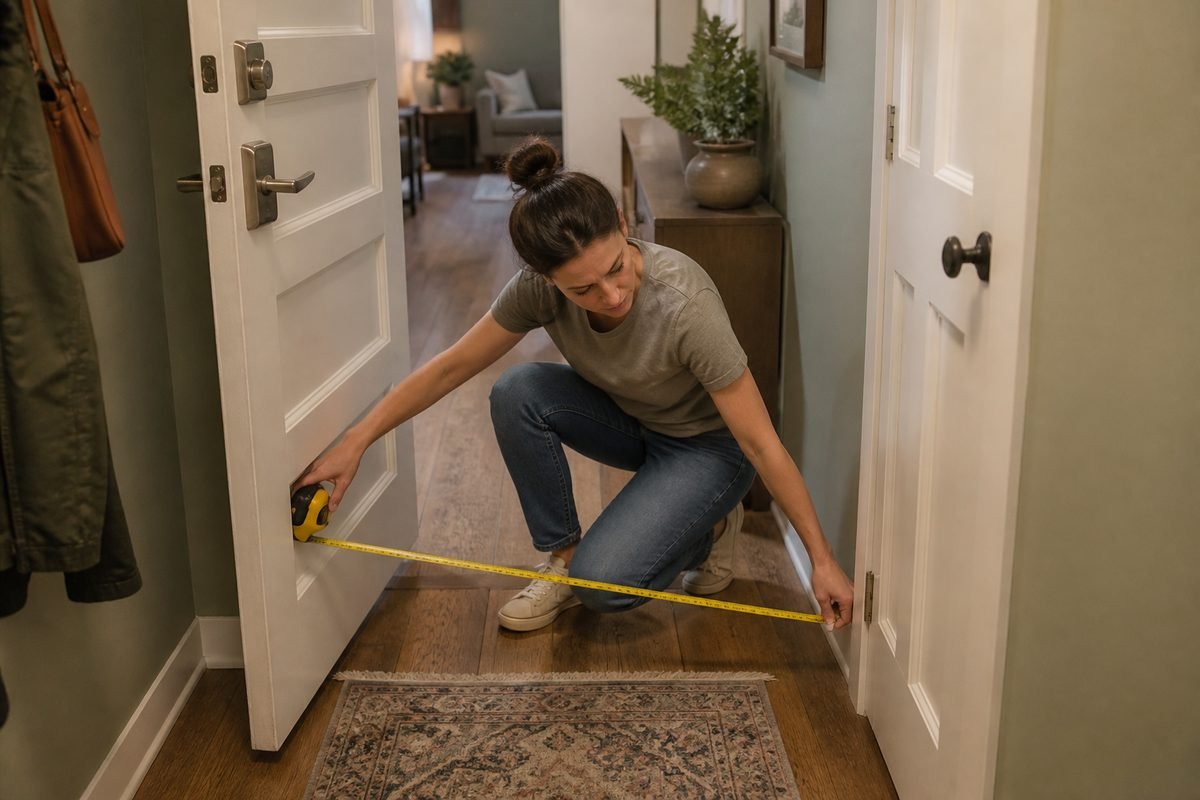
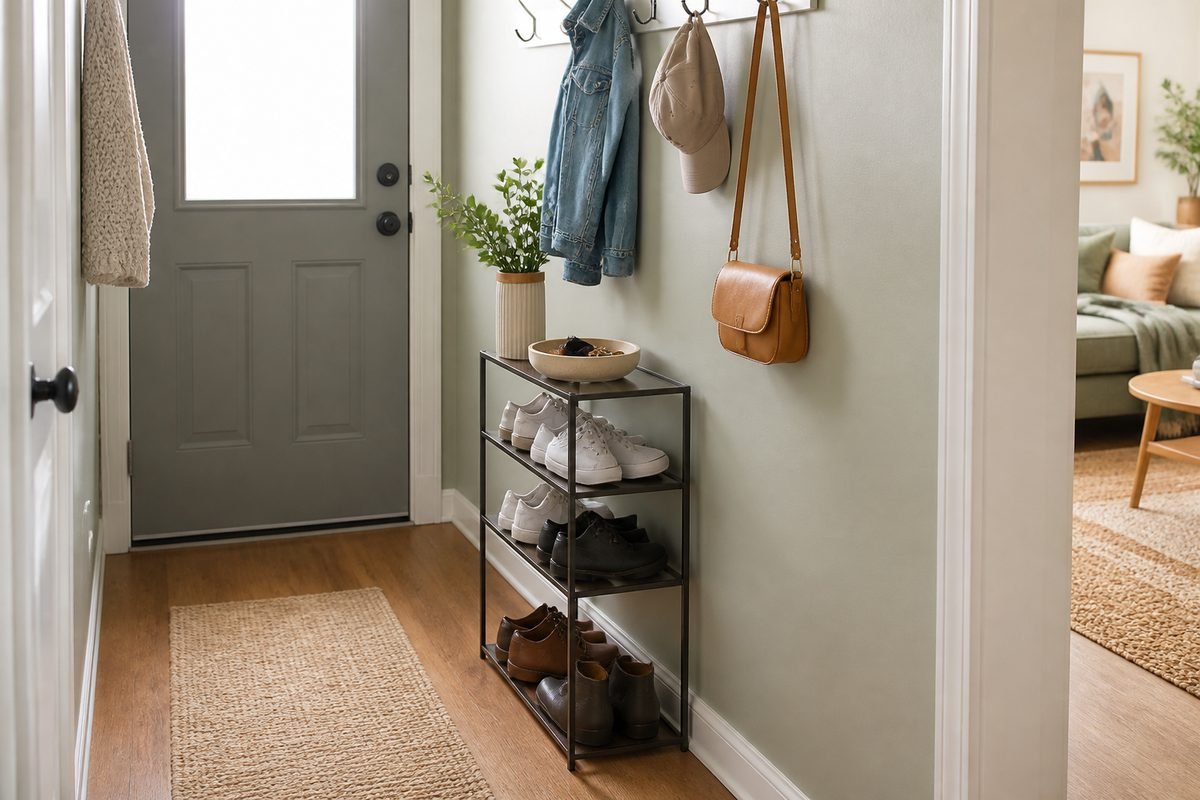
Open the entry door fully and trace its sweep on the floor with removable painter’s tape approved for the surface. Include the knob, closer, chain, deadbolt, and any object mounted to the door. Storage must not prevent full opening, closing, latching, locking, or looking through a peephole. Also test the door while wearing a backpack and carrying grocery bags; an inch that looks spare on paper may be the space your hand needs.
Measure the passage at its narrowest point after accounting for baseboards, radiators, trim, and anything protruding from the wall. Record the depth available outside the taped swing, not the total hall width. Preserve the exit route required by your lease and local rules, plus enough clear space for everyone in the household to move normally. A console that forces people to turn sideways or catches a mobility aid is too deep.
Mark light switches, outlets, vents, electrical panels, alarms, intercoms, and access panels. Do not cover or make them difficult to reach. If the entry opens directly onto stairs, keep objects and mats away from the landing edge. A loose basket or fallen coat near stairs creates a greater hazard than entry clutter.
Make a simple dimension sheet
- Clear wall length outside the door swing
- Maximum usable depth while preserving the route
- Height to switches, intercom, and thermostat
- Door thickness and trim clearance for any over-door product
- Baseboard depth and floor slope for freestanding furniture
- Location of studs only if approved wall mounting is being considered
Carry these dimensions when shopping. Product “width” may exclude knobs, tilted legs, or projecting hooks, so verify assembled dimensions and operating clearance.
Count one ordinary week of arriving items
For seven typical days, note what lands near the door: keys, wallets, mail, shoes, umbrellas, dog gear, bags, helmets, strollers, and coats. Separate daily items from occasional and seasonal gear. The entry should hold the daily set and perhaps one active backup—not every shoe or winter coat owned.
Assign a capacity before selecting a container. One tray may hold keys for two residents; a washable mat may hold two pairs of current shoes per person; one hook may be assigned to each active coat or bag. If the item count exceeds the safe footprint, rotate stock elsewhere. Capacity limits prevent a “helpful” basket from becoming an unsearchable pile.
Give mail an action, not a storage bin
Use a shallow inbox only for mail awaiting a decision. Put recycling near the route to the recycling bin, and move bills or documents to the place where they are handled. A deep entry basket hides deadlines and fills with envelopes. Labeling the tray “to process” is more useful than labeling it “mail.”
Check the lease, wall type, and load support
“Renter-friendly” does not automatically mean damage-free. Read the lease and ask management what holes, anchors, over-door racks, or adhesive products are allowed. Get approval in writing when the answer matters to your deposit. Photograph the wall before installation and save product instructions.
If mounting is permitted, identify the wall construction and use the hardware specified for both that wall and the product. Drywall, plaster, masonry, tile, hollow doors, and solid wood require different fasteners. Do not guess based on sound or copy a screw from another room. Avoid drilling where wires, plumbing, or building systems may be concealed; management should handle uncertain locations.
Adhesives can lift paint, release from textured walls, soften in humidity, or fail under a pulling coat. Reserve removable adhesive hooks for genuinely light items and inspect them. Never position a mounted object where failure could strike a person, pet, glass door, or stair.
Build the entry in a safe order
- Clear and clean the route. Remove everything, then open the door and walk through repeatedly. Keep the taped door sweep and required passage empty.
- Mark item zones. Put paper templates where a key tray, shoe mat, or hooks might go. Reach for them while entering and leaving. Common items should not require stepping back into the door swing.
- Start at floor level. Add a thin, non-slip, washable shoe mat that lies flat and does not interfere with the door. Limit footwear to the marked capacity.
- Add one landing surface. Use an existing ledge, a securely supported shallow shelf if permitted, or a stable narrow table only when the passage allows it. The surface should hold a key tray—not become a second countertop.
- Provide supported hanging. Choose approved wall hooks, a stable coat stand, or an over-door rack only after checking loads and interference. Place heavy bags low or elsewhere.
- Test with real loads. Add coats and bags gradually, respecting ratings. Open and latch the door, use every switch, and walk the path with groceries. Remove anything that shifts, sways, snags, or narrows movement.
- Move overflow out. Store off-season coats and extra footwear in bedroom storage, under-bed bins, or another approved location. The entry’s empty space is functional capacity.
Choose storage by depth, stability, and job
Shallow tray or wall pocket
A small tray corrals keys and a wallet without hiding them. On a permitted wall, a lightweight mail pocket can work if its contents remain light and it is mounted as directed. Avoid placing either where the door handle can hit it. Empty the tray of receipts and coins during a regular reset.
Shoe mat, low rack, or bench
A mat consumes the least depth and shows when capacity is exceeded. A low rack adds levels but must remain stable when shoes are removed one-handed. A bench needs both sitting depth and knee space; in a truly narrow passage it often creates more obstruction than value. Never sit on a shoe cabinet unless it is designed and rated as seating.
Coat stand
A floor stand avoids wall holes but needs a broad, stable base and balanced loading. Put heavier coats on lower hooks and distribute weight around the stand. If it tips when one bag is removed, it is unsuitable for the entry. Keep it outside the door sweep and away from stairs.
Over-door rack
Before using one, verify door thickness, top clearance, hinge capacity, closer operation, weather seal, and trim. A rack can scrape the frame, keep an exterior door from sealing, stress hinges, or prevent latching. Install it only if the door closes and locks normally without force. Remove it if it changes the fit or creates noise.
Mirror
A mirror can make the entry brighter, but it is not a light adhesive accessory. Use a product and support system suitable for its weight and wall, with lease permission. A freestanding leaning mirror can slide or tip and is generally a poor choice in a tight route. Consider a lightweight, securely mounted alternative only when instructions support it.
Umbrella and wet-gear storage
Use a waterproof, stable container that cannot tip into the path. Let wet coats and umbrellas dry with ventilation rather than compressing them into a closed basket. Protect flooring and empty collected water. If the exterior door leaks rain, report the defect instead of treating an umbrella stand as a drainage solution.
Three narrow-entry examples
An inward-swinging apartment door
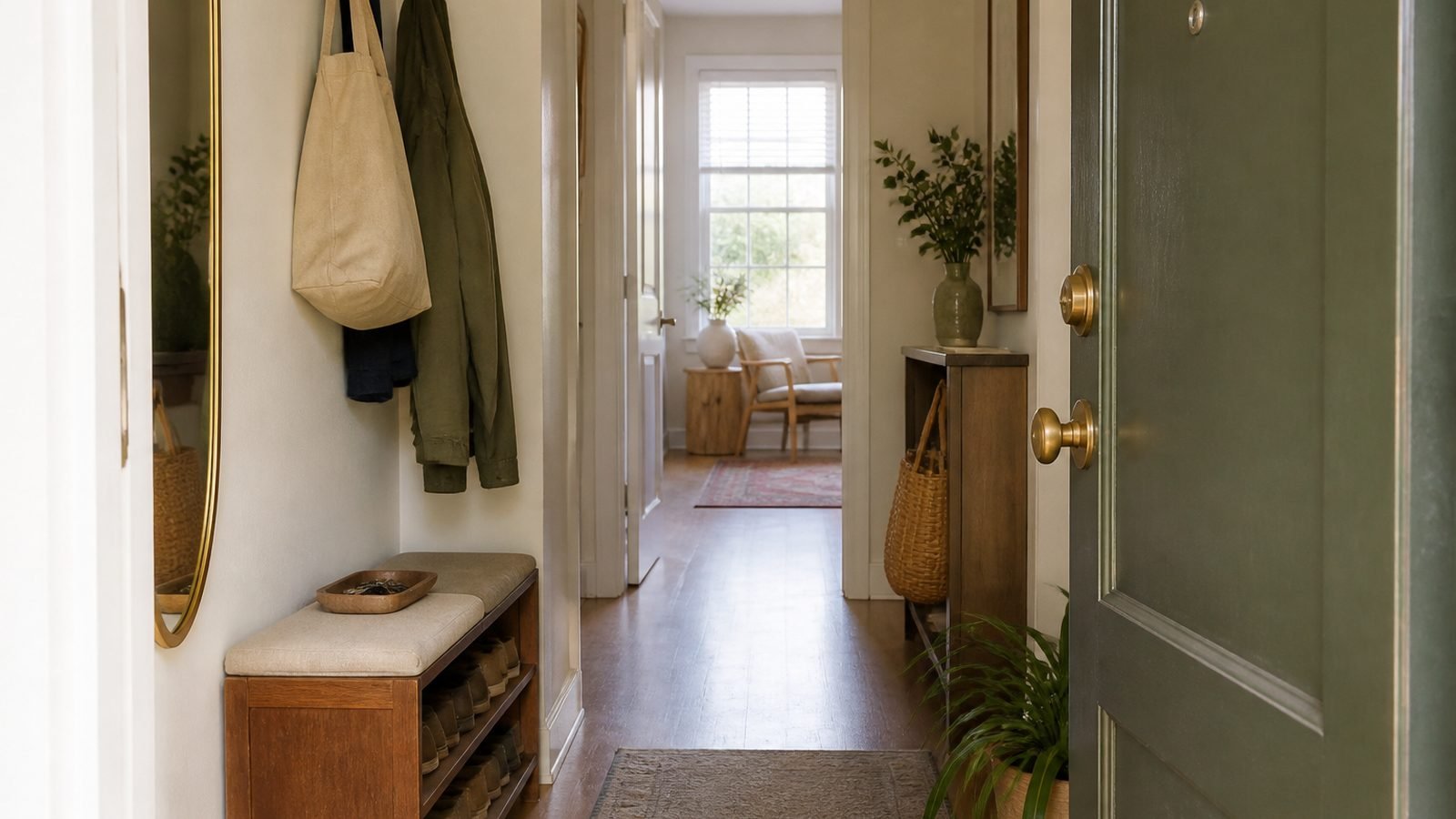
The door consumes most of one wall. The renter keeps the entire sweep empty, puts a thin two-pair mat on the opposite side, and uses an existing six-inch-deep ledge for a key tray. With permission, two properly mounted hooks sit beyond the handle’s reach. Extra coats remain in the bedroom.
A corridor with no usable wall depth
No cabinet fits without narrowing movement, so storage is limited to a flat mat and a tray inside the nearest kitchen cabinet. Each resident carries their bag to its home. This solution stores less, but the entry remains safer and easier to clean.
A door that opens near stairs
The landing and stair edge stay completely clear. Shoes go in a stable rack beyond the landing, not against the first step. Keys use a securely supported tray farther inside. Nothing hangs where it could fall onto the stairs.
Keep storage within its capacity
- Carry bags to their room after unloading instead of hanging them indefinitely.
- Move dry off-season shoes and coats to secondary storage when weather changes.
- Process mail before the shallow inbox fills.
- Shake out and wash the shoe mat according to its care label; replace it if edges curl.
- Inspect hooks, anchors, adhesives, racks, and furniture for movement. Unload immediately if support changes.
- Confirm periodically that the door still opens, closes, latches, locks, and seals without rubbing.
The five-minute zoning method in How to Create Zones in a Studio Apartment Without Dividers can keep arriving objects from spreading into the main room. For overflow clothing, use the inventory and capacity process in How to Store Clothes in a Small Bedroom With No Closet.
Frequently asked questions
Are removable hooks safe for coats?
Only when the hook maker allows the surface, load, installation direction, and environment, and the loaded coat stays below the stated rating. Wet coats and bags can be heavier than expected and create pulling forces. Approved mechanical mounting or stable freestanding storage may be more appropriate.
How deep should an entry console be?
There is no universal depth. Subtract the clear route you must preserve from the measured passage, then account for baseboards, knobs, and body movement. If normal passage becomes awkward, use a shallower tray or no furniture.
Can shoes be stored behind the door?
Only if they remain completely outside the full swing and cannot slide beneath it or prevent latching. A defined mat beyond the swing is easier to inspect than loose shoes.
What belongs in the entry year-round?
Keep items used for current departures: daily keys, active footwear, one current coat or bag, and necessary mobility or pet gear. Seasonal and occasional inventory should live elsewhere.
Conclusion
The best narrow entry is not the one with the most organizers. It is the one where the door operates fully, the exit route stays clear, and each daily object has a small, supported place. Measure first, verify permission and weight support, test with real loads, and let strict capacity limits protect the empty space you need to move.